

The Loglines
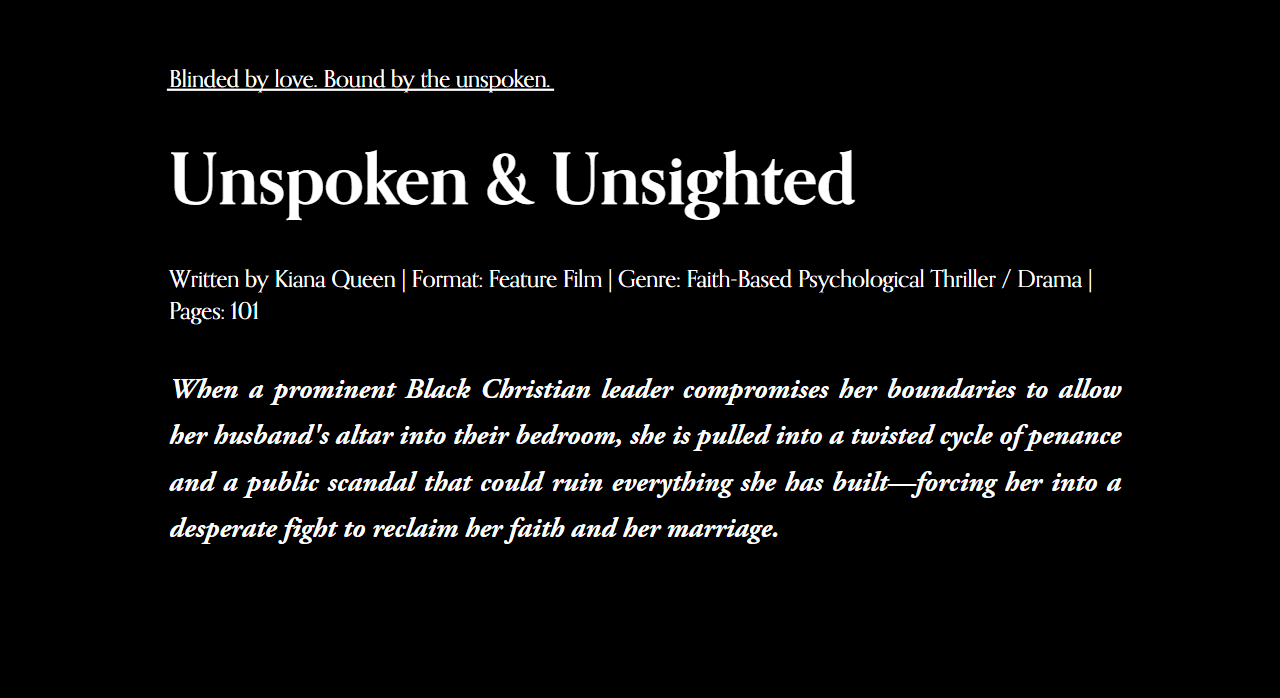
Creative Slate & Vision
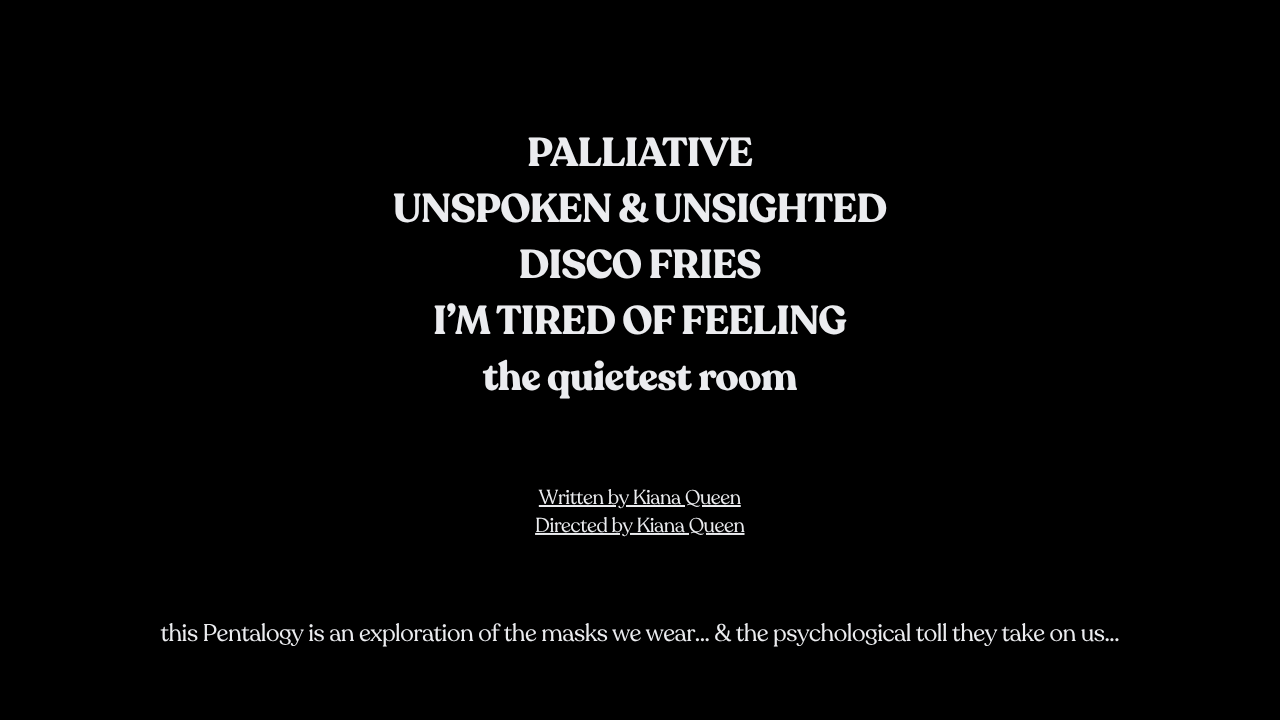
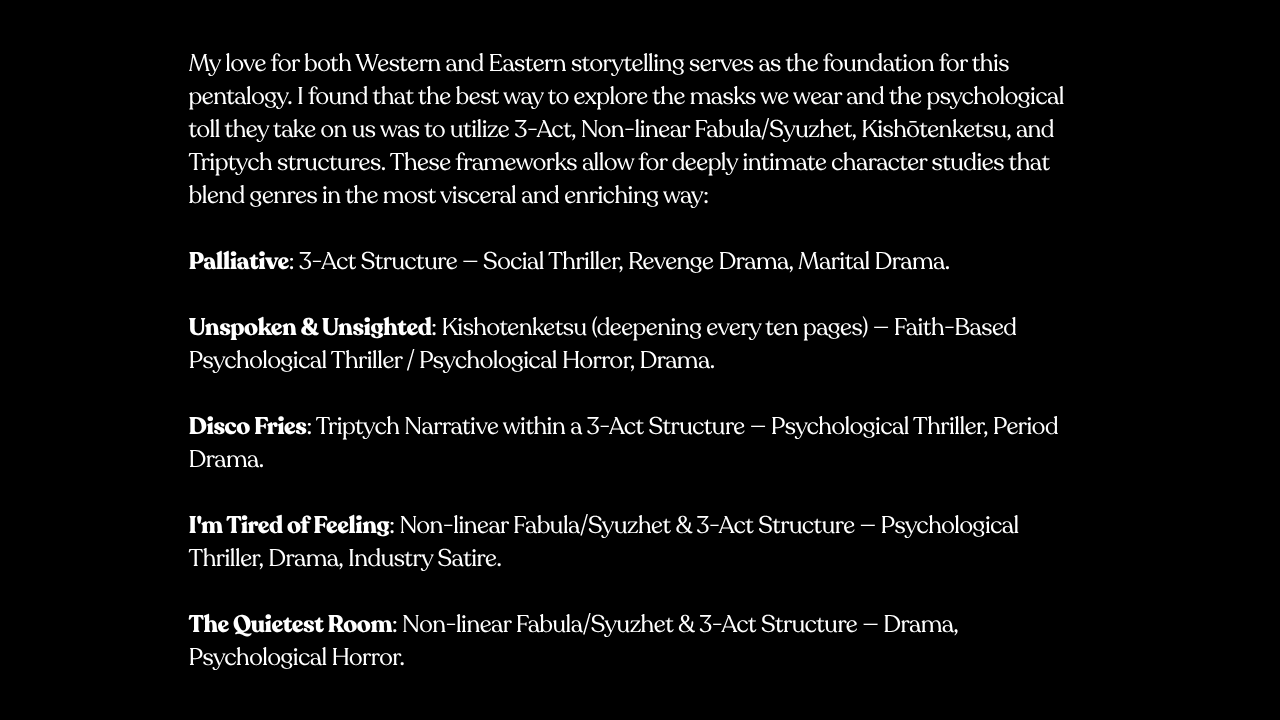
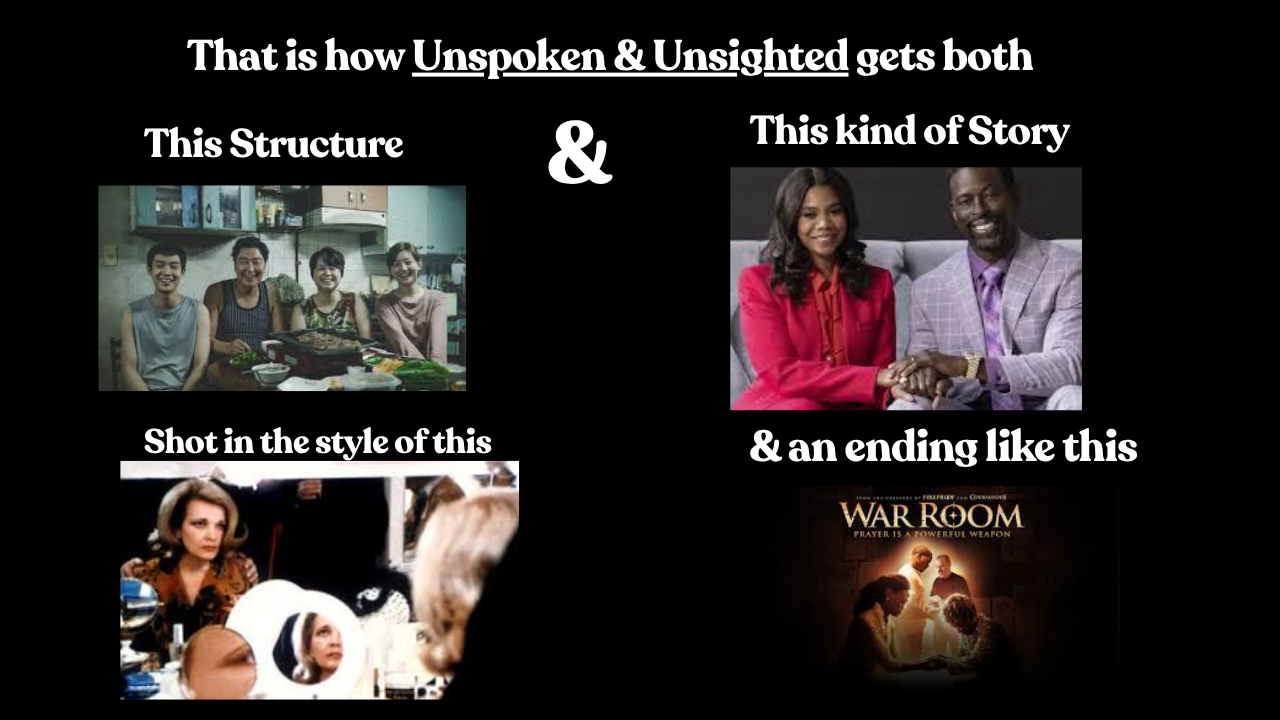
At its core, this pentalogy is a deep character study of women navigating layered narratives—an exploration of the masks we wear and the psychological toll they take on us. I found that the best way to explore those emotional complexities was by merging my love for both Western and Eastern storytelling—utilizing 3-Act, Non-linear Fabula/Syuzhet, Kishōtenketsu, and Triptych narrative structures. By blending these frameworks, the pentalogy delivers emotionally resonant, genre-blending character studies that center complex Black women and men, supported by rich, dynamic ensembles. Grounded in my roots, the entire slate is designed to be filmed almost exclusively against the backdrop of New Jersey. The sole exception is a brief, vital trip to Abuja, Nigeria, to capture the awe-inspiring 100,000-capacity Glory Dome at the Dunamis International Gospel Centre for Unspoken and Unsighted. While each script stands alone, they share complementary themes and build upon one another to create a cinematic event that begins first with the raw exploration of human behavior by our actors. To bring healing and wholeness to a generation that endures trauma and depression like never before, these scripts all subtly weave in the comfort that brought me through my own dark seasons—that is, Christ.
My intent is to bring this entire pentalogy to life by directing all five features. By combining incredible talent with the freedom of vérité-style shooting, these features will have a deeply visceral, lived-in feeling. Allowing the camera to serve this generation's best actors will be key in bringing these stories to life and selling their emotional truths. Built upon the foundation of these elevated, character-driven scripts and the actors attached to them, I know that something truly special can be made here.
By utilizing an agile production model and an on-set editor, this pentalogy is designed to be shot and released in a highly efficient time frame. After a meticulous pre-production and rehearsal period, my goal is to shoot all five films over a continuous six-month production window, dedicating about 20 to 30 days to film each one. This mirrors the efficiency of the classic studio era and B-movies, as well as the methods utilized by many of our great independent directors today on films such as Moonlight and Dallas Buyers Club.
The vision culminates in a groundbreaking theatrical event spanning a single month, partnering with movie theaters to release two discounted double features every other week (Palliative paired with Unspoken and Unsighted, followed by Disco Fries paired with I'm Tired of Feeling), wrapping up with a single-feature release of The Quietest Room. This ambitious, rapid-fire release strategy is designed to leave a massive and lasting impact on cinema and on the hearts of audiences around the world.
Please enjoy the partial lookbook located on the next tab. Underneath it, you will find a deeper dive into my directorial vision and the detailed production strategy engineered to bring this pentalogy to life—using some of the very same methods the old Hollywood system utilized to produce some of our favorite films.
~ Kiana Queen
The Lookbook
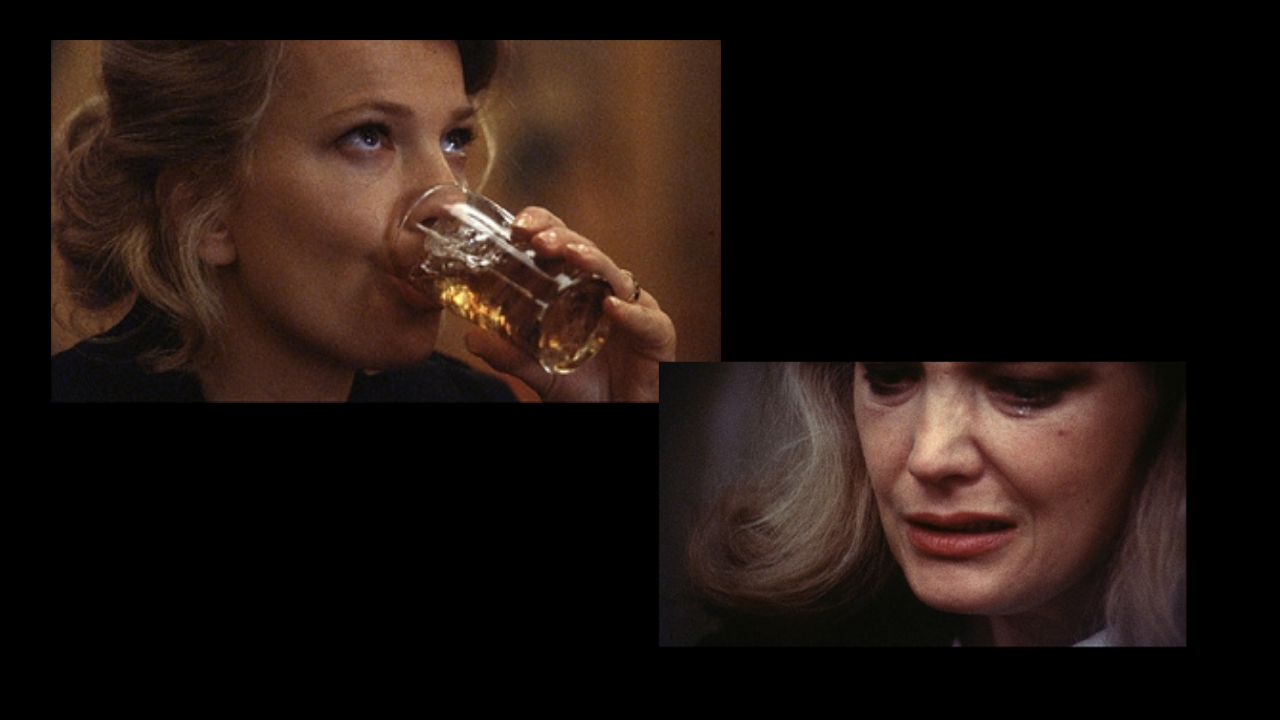
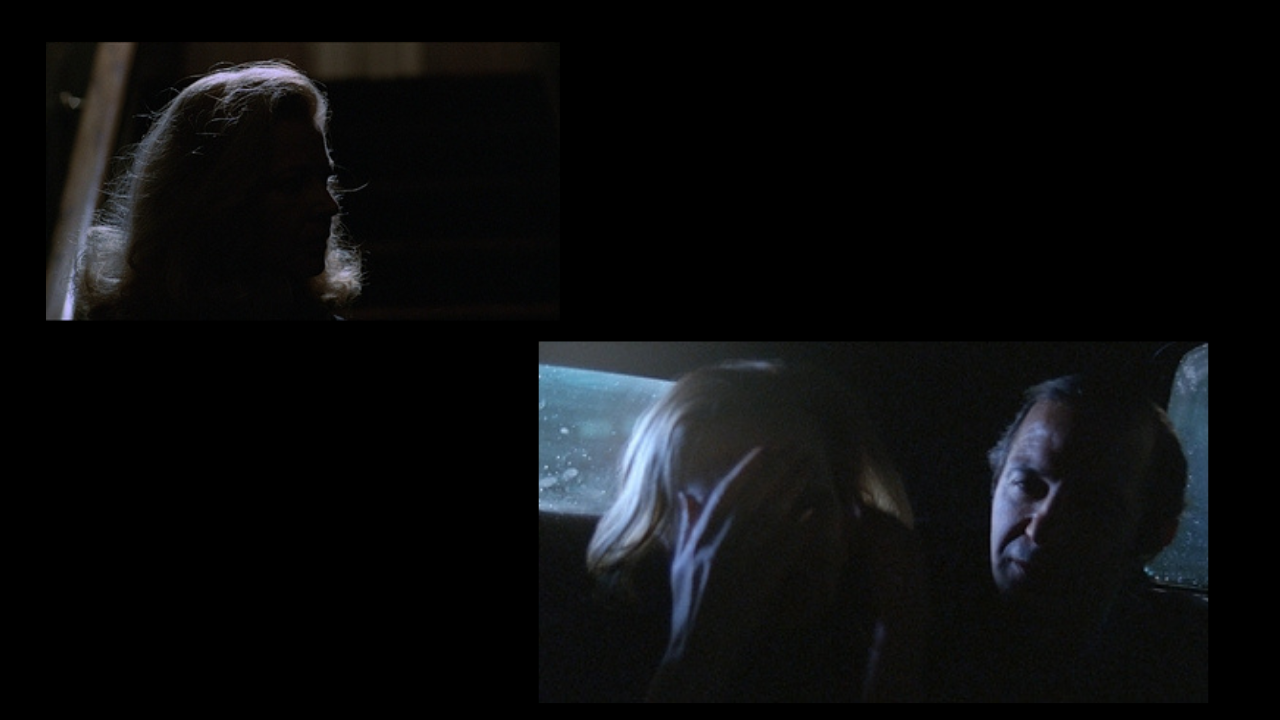
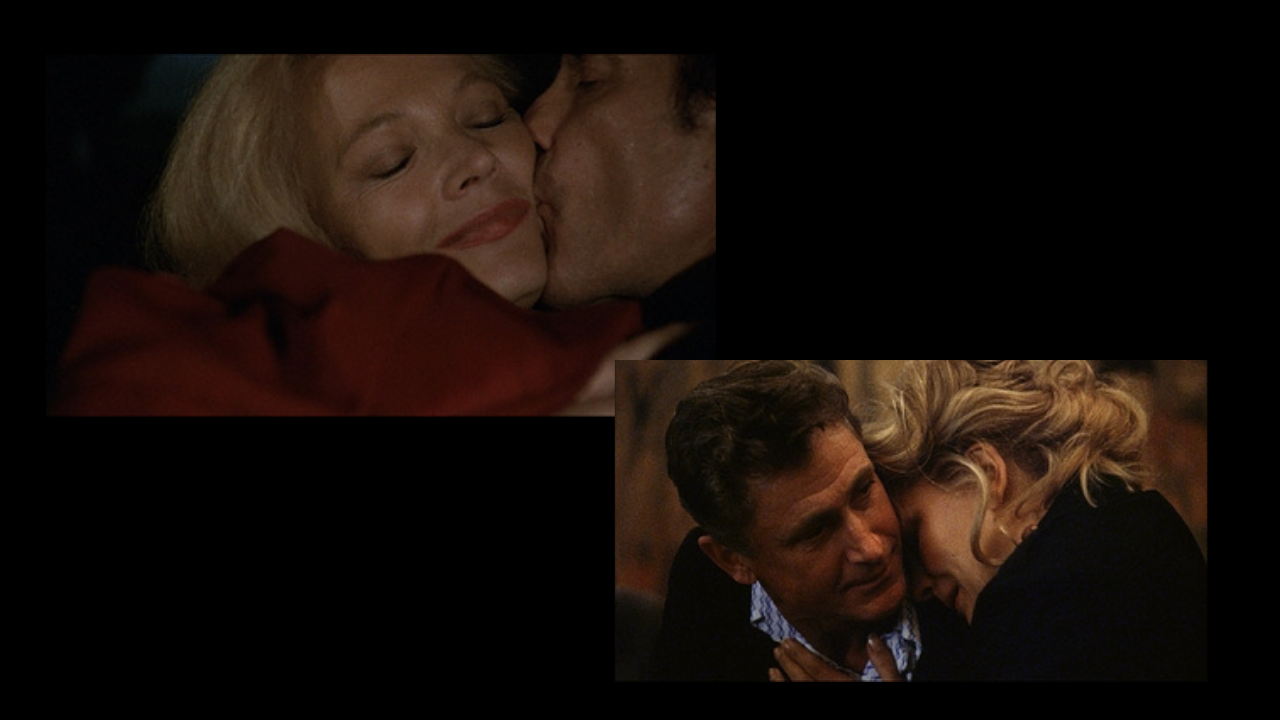
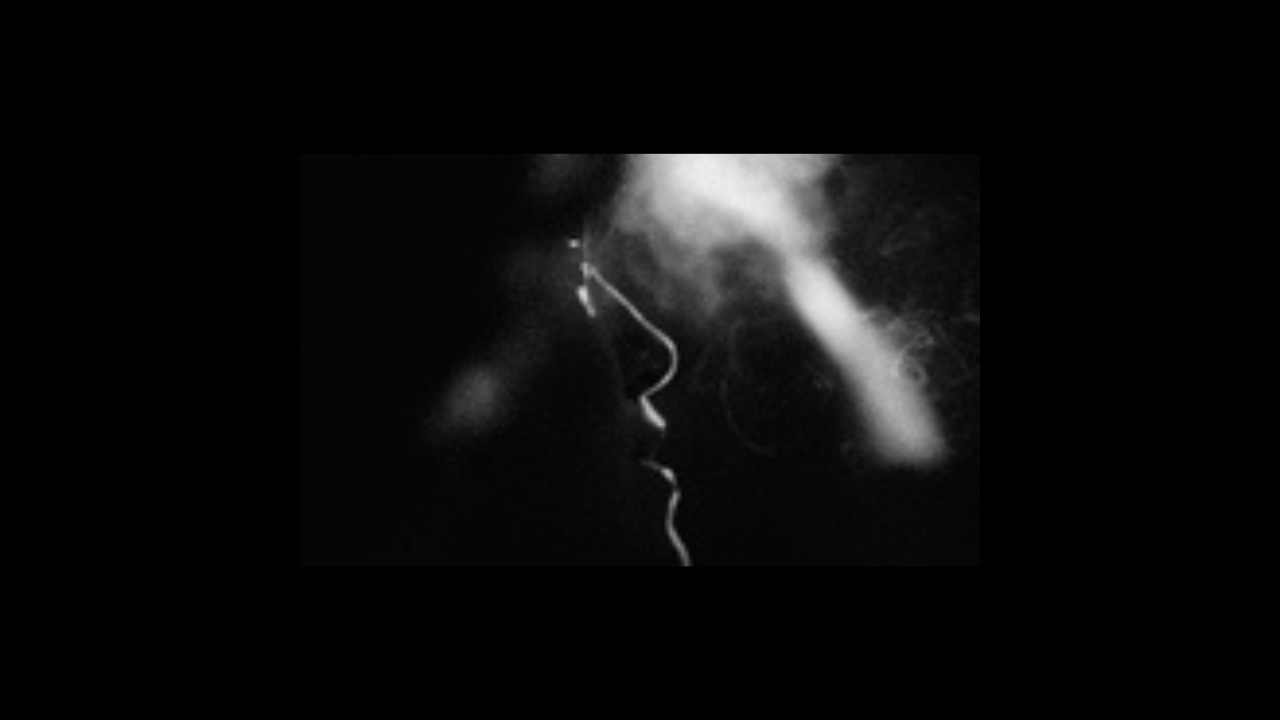
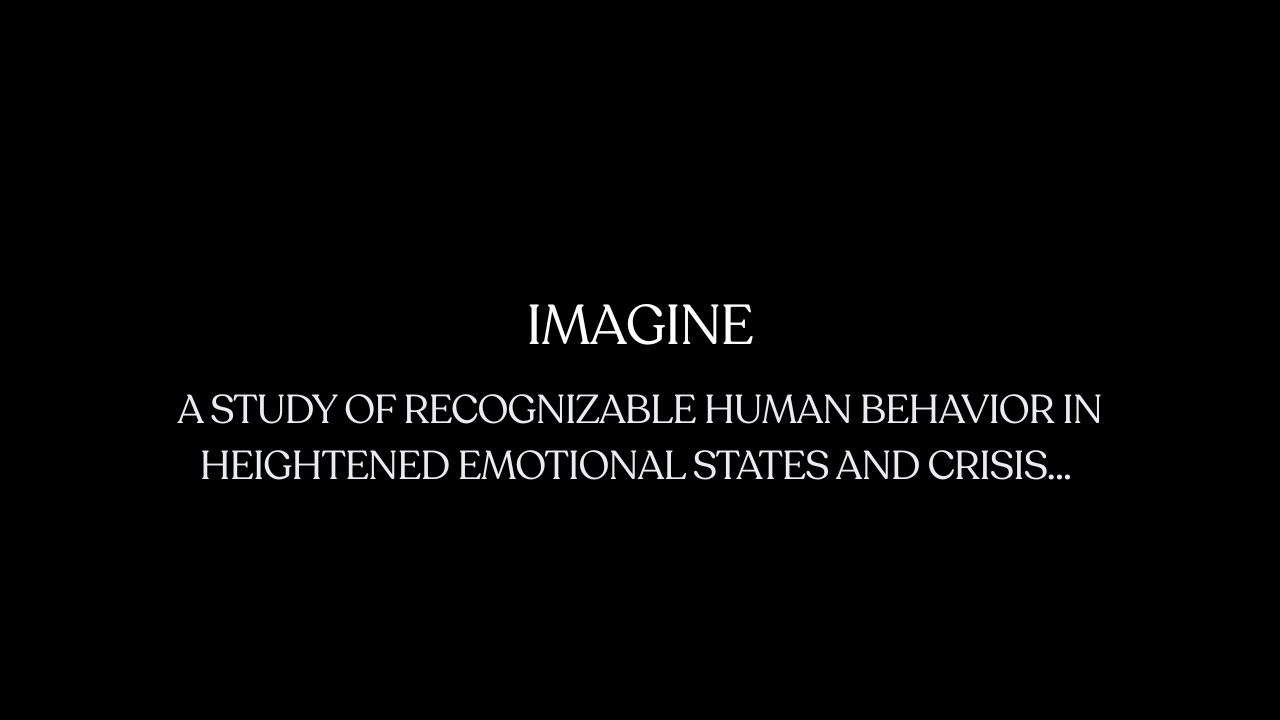
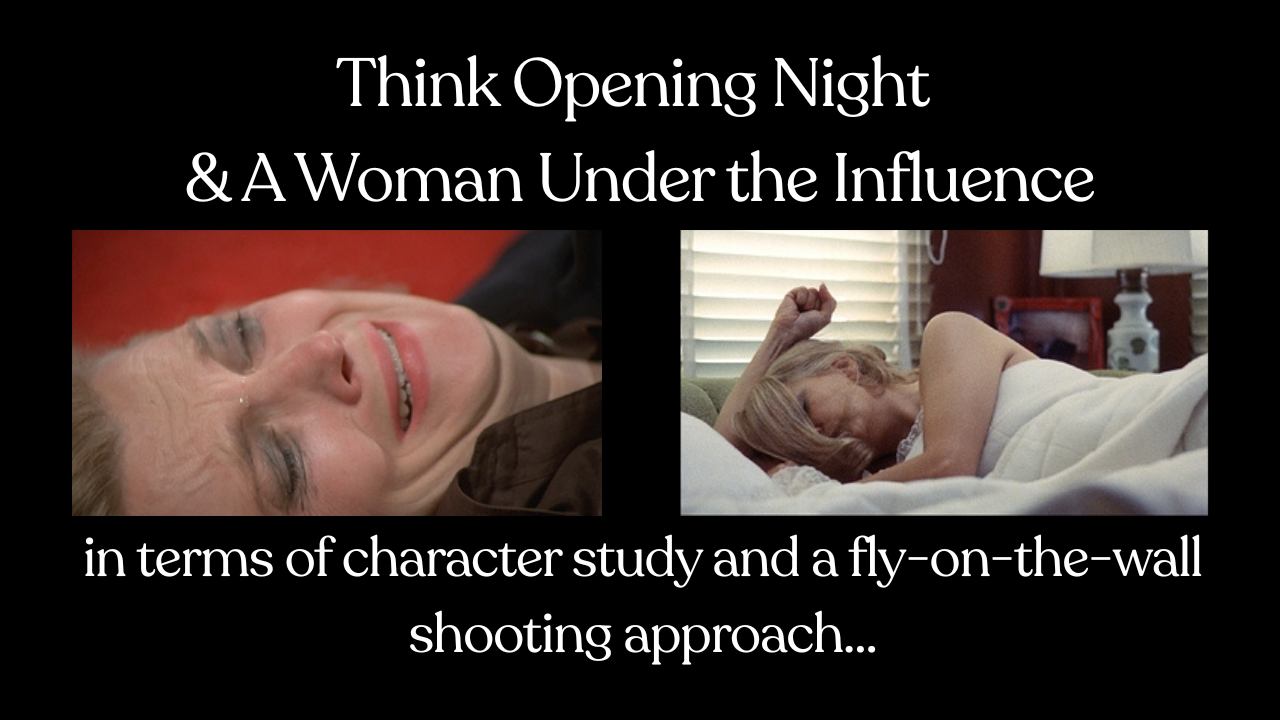
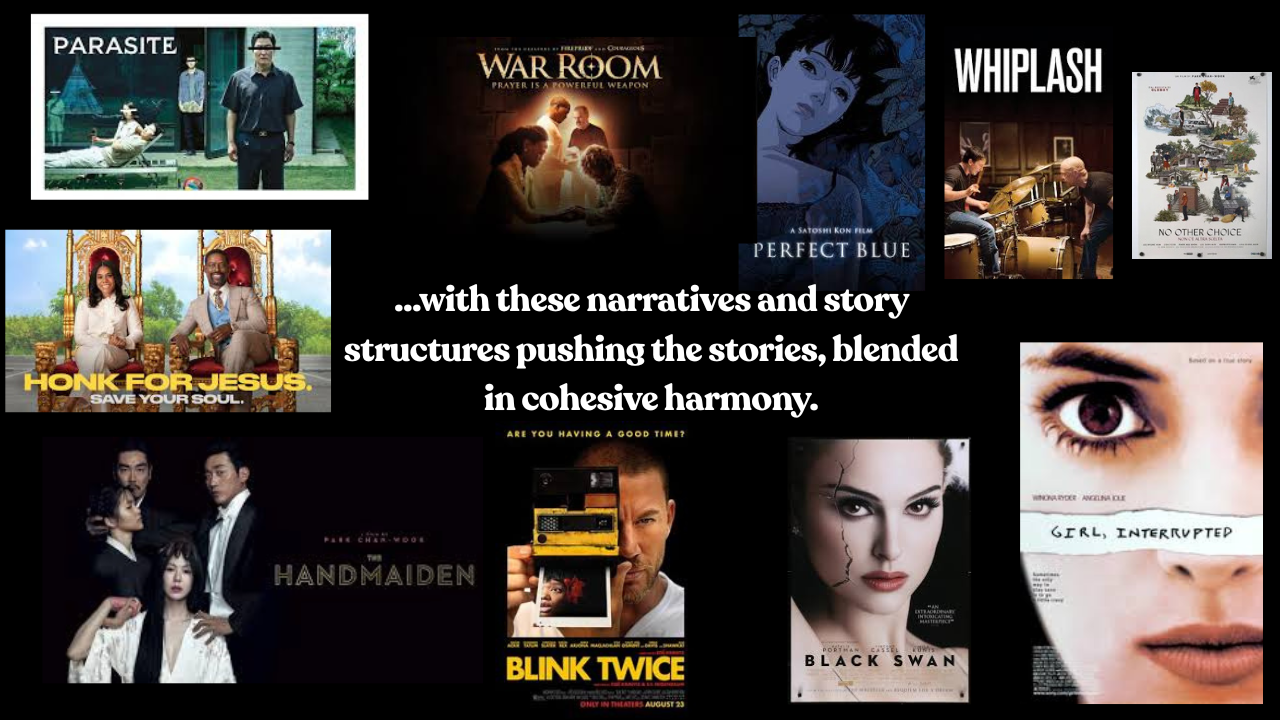
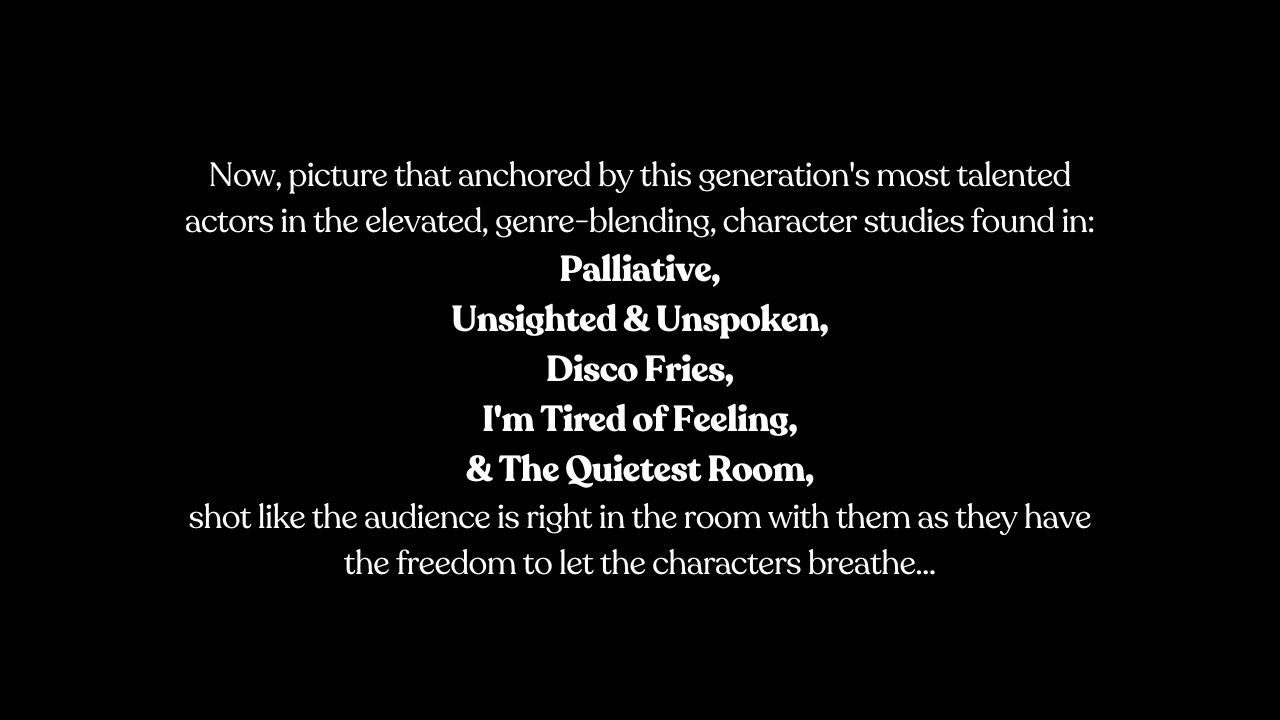
Director’s Vision
Following a meticulous pre-production period, my ambition is to film this entire pentalogy over a continuous six-month production window, dedicating about 20 to 30 days to shoot each film. To execute this timeline without ever sacrificing the emotional depth of the performances, we will merge the raw, agile spirit of independent filmmaking with the highly efficient machinery of the old Hollywood studio system—a system that actually originated right here in New Jersey. With massive, state-of-the-art studio lots currently breaking ground and nearing completion across the state, our physical production is strategically timed to commence once these facilities are fully built in 2027/2028. There has never been a more perfect time to anchor a production of this scale here. Below are the specific strategic steps and production architectures that will make executing this massive feat run as smoothly as possible.
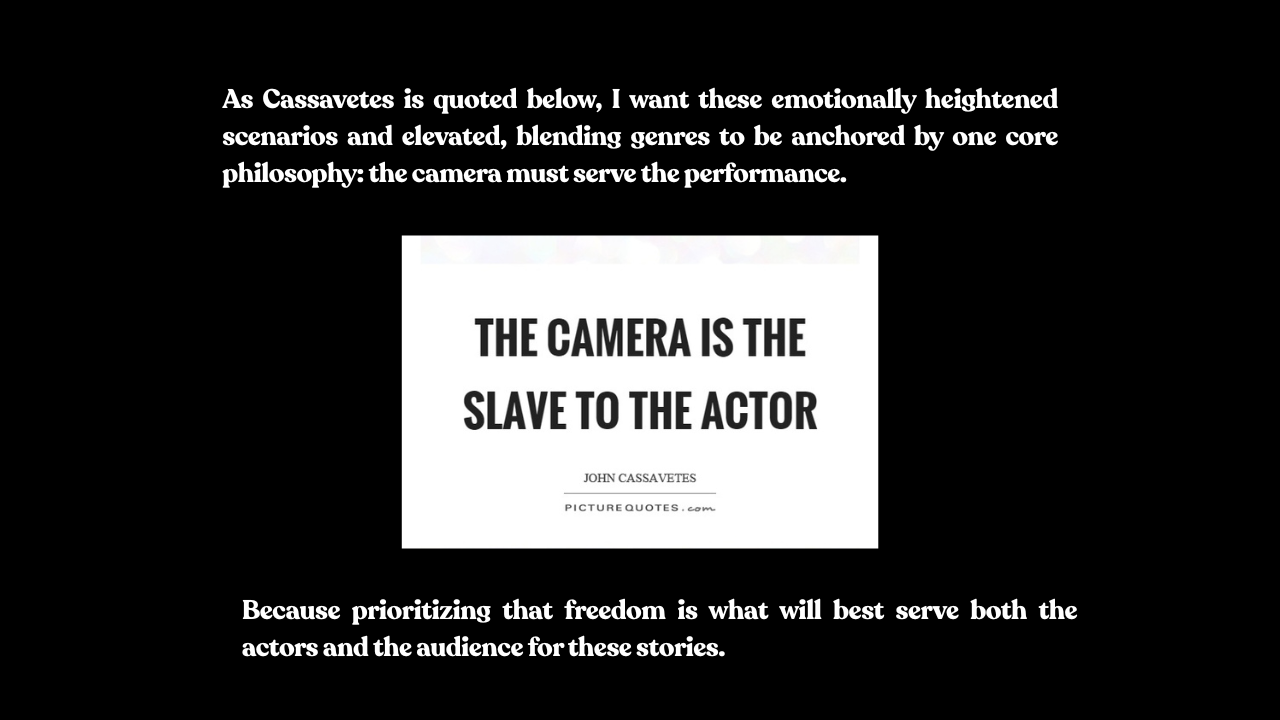
Within this highly efficient framework, I want to combine incredible talent with the freedom of a fluid, reactive camera, so that these features will have a visceral, lived-in feeling. This fly-on-the-wall approach is chosen to serve both the audience and the actor—allowing the cast the physical space to reach their character's emotional beats without the distraction of technical marks. I want these stories to feel so deeply personal that the audience feels they are invading the intimate moments where a character’s mask finally begins to slip. This visual approach directly serves the pentalogy’s exploration of the masks we wear and the psychological toll they take on us.
If you have not yet requested the scripts, I invite you to do so. Once you read them, you will see that the framework presented here isn't just theory…it is built on an unwavering confidence in the material. The pages speak for themselves, but it is only when partnered with the caliber of talent envisioned that this vision is fully realized.
I invite you to join me in bringing these stories to life.
Production Strategy
-
Before we get into the production strategy, if you have read the loglines or the scripts, you know they are vulnerable and intimate portrayals that reflect the heavy complexities of life. Therefore, before discussing any business or production models, I must first establish my most sacred responsibility: the physical, emotional, and spiritual safety of my cast and crew. This is why I will have a standby therapist on set for both cast and crew should any unresolved traumas or triggers arise—a protocol detailed further below.
I want to preemptively reassure everyone involved—from my actors to my crew and investors—that there is not a single word in these scripts written for shock value. Every moment exists exclusively to serve the character-driven narratives, and every single story within this pentalogy ultimately ends in a hopeful place.
Because these films navigate profound trauma and vulnerability, any scene that is delicate or contains intimacy will be strictly choreographed by a vetted intimacy director. These sequences will be meticulously blocked to ensure they serve the story and the emotional truth of the characters, never an audience’s fantasies. I will never ask an actor to perform an action they are uncomfortable with, and their personal boundaries will always be respected as the final word.
To put this commitment into immediate practice: for Unspoken & Unsighted, a film that requires immense vulnerability and vocal exertion, I have already consulted with the founder of Vocal Combat Technique—a specialized practice that helps actors go to extremes in a healthy way. They have recommended two specialized female vocal coaches and an intimacy director who will be brought on to ensure that our lead actress's most demanding scenes are handled with the utmost care, protecting both her emotional well-being and the physical health of her instrument.
-
This pentalogy is made possible by New Jersey’s filmmaking infrastructure and a shifting cinematic landscape. The phenomenon of Barbenheimer proved the hunger for "event" cinema, while the success of Sinners validates the power of elevated genre-blending with Black casts and strong ensembles. Furthermore, the global impact of Parasite and the massive resonance of War Room demonstrate that audiences are hungry for narratives that break traditional molds and speak to spiritual truth.
But fundamentally, this work is built upon the trailblazers who laid the foundation of this industry right here in New Jersey. Specifically, I must honor Alice Guy-Blaché—the visionary who founded Solax Studios in Fort Lee, becoming the first woman to ever own and direct her own studio. In 1912, she created A Fool and His Money, the first-ever film with an all-Black cast.
Her early trailblazing—alongside the artistry of creators like Ava DuVernay, Ryan Coogler,Park Chan-wook, Bong Joon Ho, Martin Scorsese, The Erwin Brothers, and others—has shown time and again that audiences crave complex, character-driven works. Their success is the proof of a reality where this pentalogy can be made and impact the future of cinema.
-
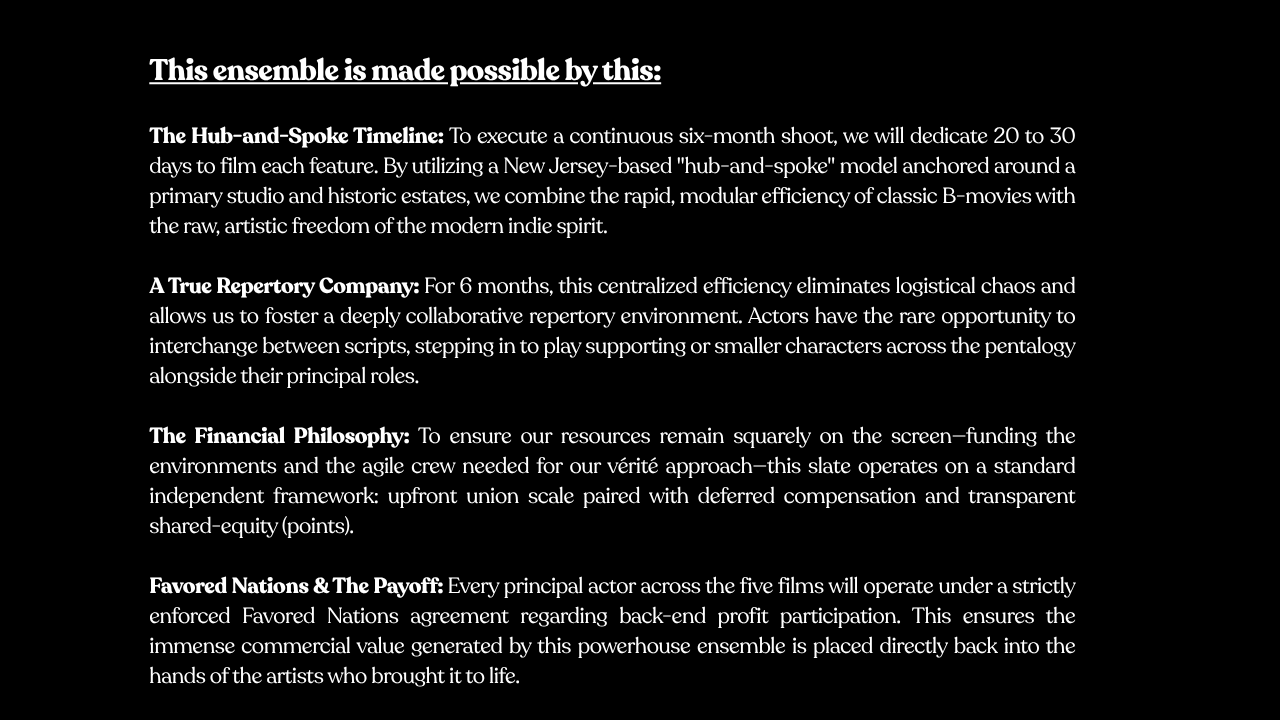
Before the industry moved West, the original motion picture studio system thrived in New Jersey through hyper-efficient, centralized filmmaking. To successfully pull off this continuous five-feature shoot, I am reviving their most effective methods: combining the rapid, efficient pacing of classic Hollywood B-movies with the raw, artistic freedom of the modern indie spirit. By ensuring my pre-production phase is meticulous, the actual physical filming of these five features can run as smoothly and expertly as possible.
To best support the stamina and creative energy of my team across this ambitious slate, I will streamline the production's footprint by anchoring the shoots around a primary studio hub and a select few historic estates, utilizing my art department to redress and transform these standing locations for each film. Furthermore, I am returning to the concept of a true repertory company—but with an open-door policy. Marrying this hyper-efficient model with the caliber of professional, generational talent I envision gives my primary cast the rare opportunity to jump into smaller, featured roles across the other films if a character speaks to them. It is an artistic invitation, not a contractual mandate, allowing them to collaborate and play with their favorite artists across multiple projects. (For a deeper dive into the logistics and financial structure of this exact model, please see The Production Architecture & Ensemble Equity below).
-
To honor the time, energy, and caliber of the artists involved, this pentalogy is designed with a highly efficient, centralized production model based in New Jersey. Rather than enduring the fatigue of constant company moves, we will utilize a hub-and-spoke approach. The productions will be anchored around a select few practical, historic estates alongside a primary studio hub. By building modular, standing sets that our art department will meticulously redesign and transform between each feature, we eliminate logistical chaos. This provides our cast with a stable, highly controlled environment, allowing everyone to focus entirely on the emotional heavy lifting of the performances—a modern return to the efficiency and focus of the classic Hollywood studio system.
Equally important to the physical production is the financial philosophy of this ensemble. To ensure that our resources remain squarely on the screen—funding the environments, the vintage glass, and the agile crew needed for our vérité approach—this slate operates on a standard independent framework: upfront union scale paired with deferred compensation and a transparent, shared-equity model.
Every principal actor across the five films will operate under a strictly enforced Favored Nations agreement regarding back-end profit participation, ensuring a completely level playing field. I am structuring the pentalogy this way out of absolute confidence in what we are building. The unprecedented combination of this powerhouse ensemble and the visceral, timely nature of these interconnected stories is designed to command a premium in the theatrical and acquisition markets. The ultimate goal of this model is to ensure that the immense commercial value generated by these performances is placed directly back into the hands of the artists who brought them to life.
-
To execute this ambitious six-month timeline, our agile location strategy will put the hub-and-spoke model into direct practice. A major part of this strategy involves treating a historic New Jersey property—Kip's Castle—like our own private backlot, redressing it to serve the distinct visual needs of multiple films in the pentalogy.
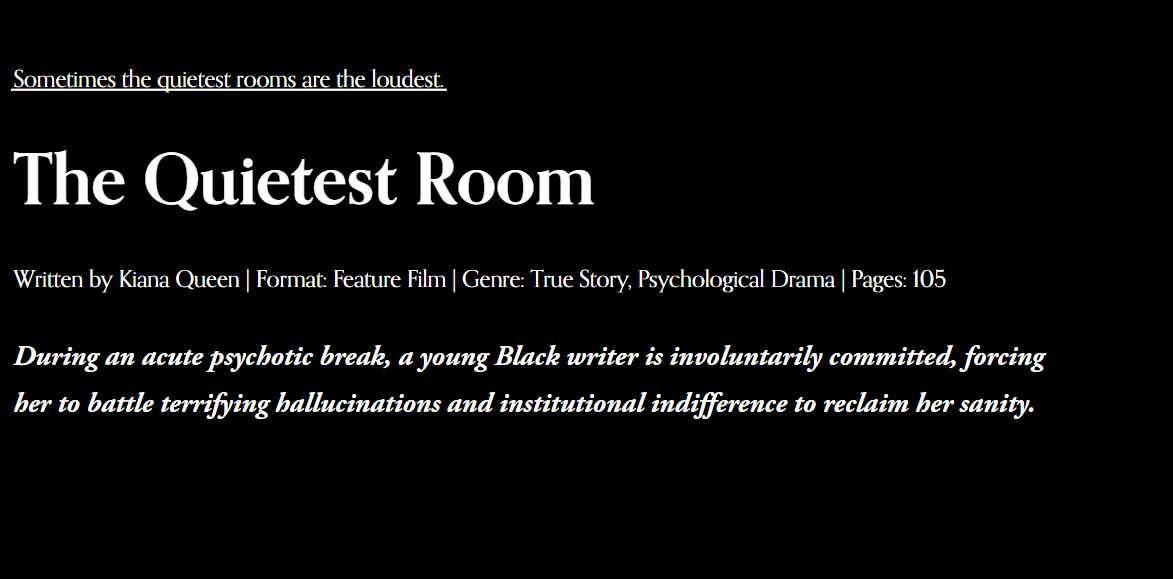
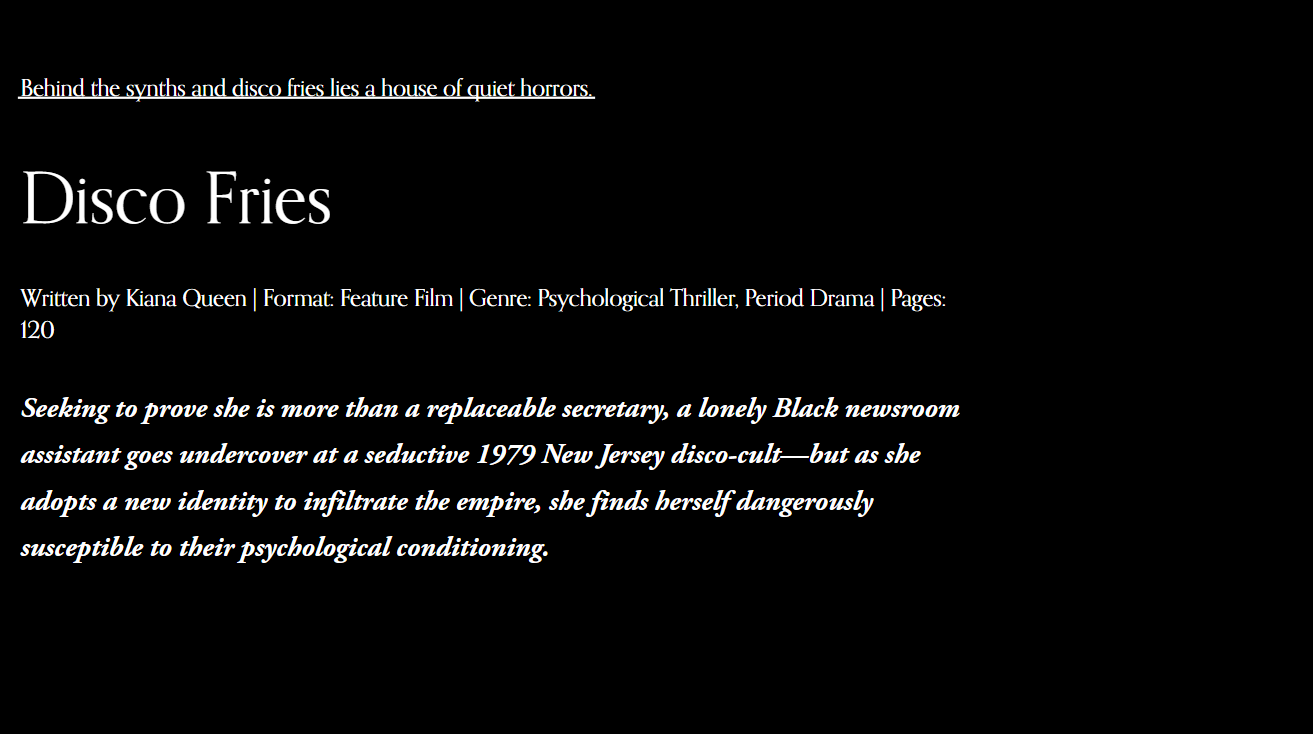
For Disco Fries, our 1979 period cult thriller, Kip's Castle offers built-in authenticity. Because we are leaning directly into the estate's real history—in the 1980s, the castle was actually occupied by the Bhagwan Shree Rajneesh cult—it provides the exact energy and layout needed to capture the psychological descent of the script.
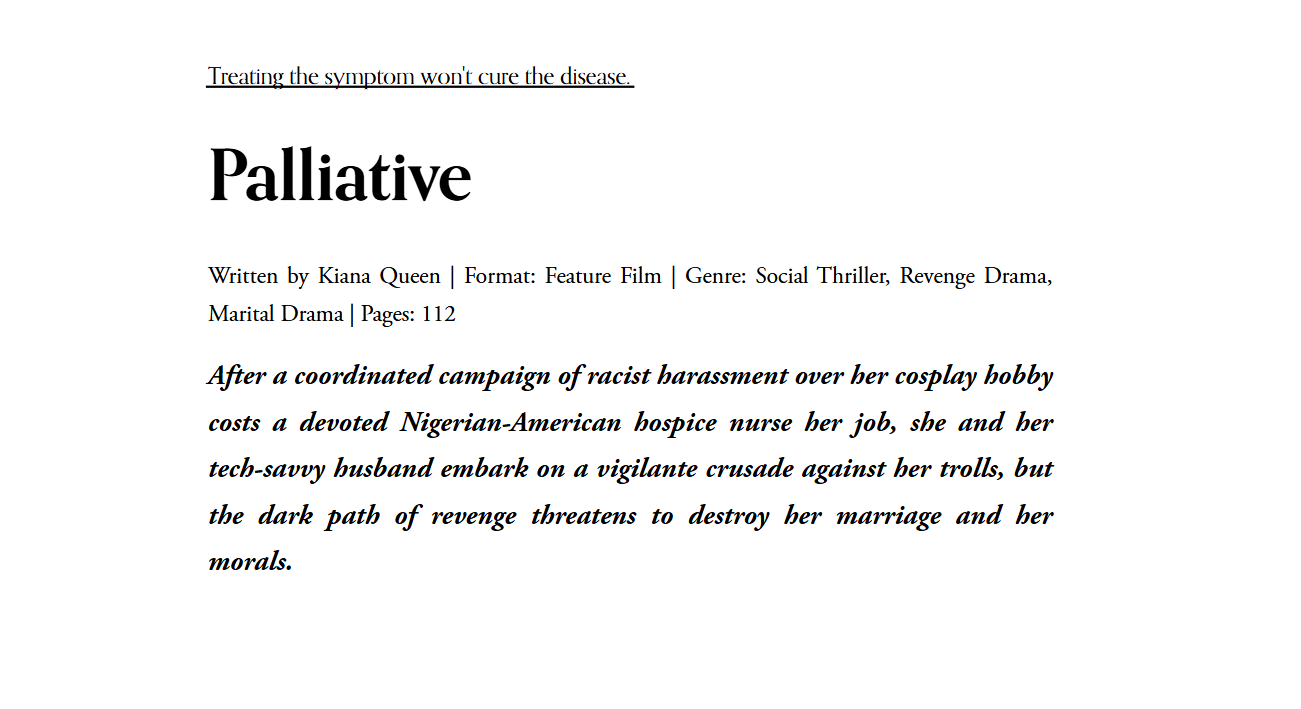
We will then seamlessly redress the grounds and interiors to serve as the private estate in Palliative.
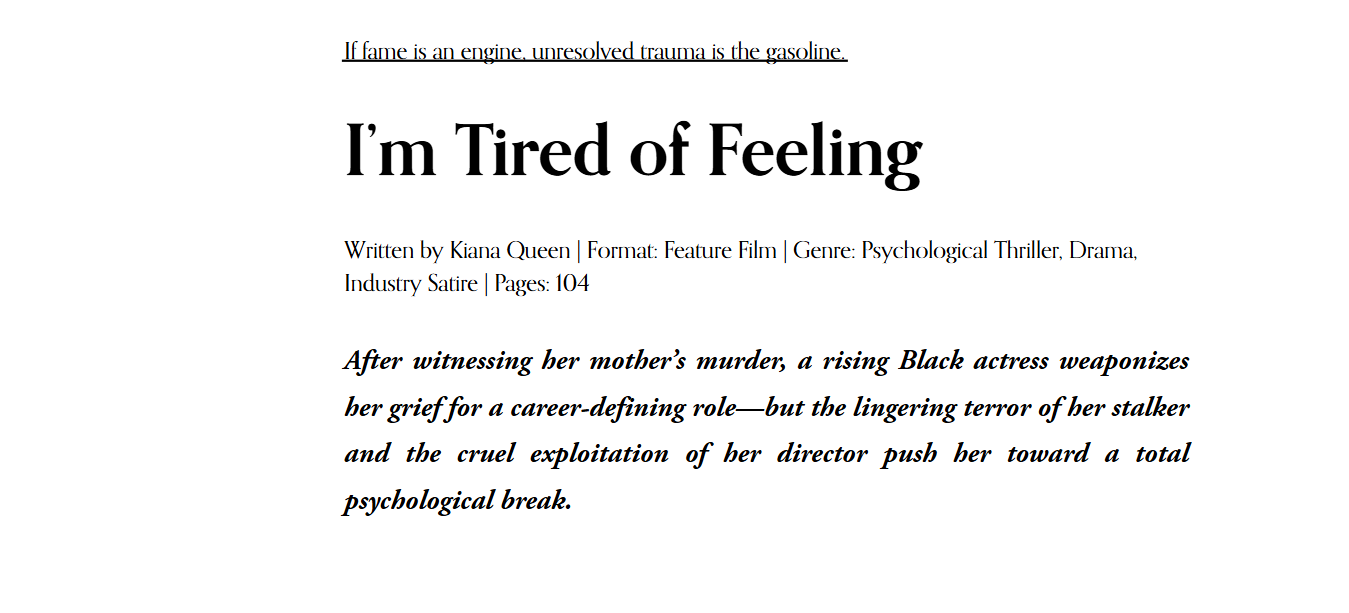
Additionally, whatever luxury property we secure to serve as the home of Marquis, the famous actor in Unspoken & Unsighted, will be redressed to double as the estate of Marcus, the affluent director in I'm Tired of Feeling.
By centralizing our core locations and redressing these primary sets across the slate, we drastically eliminate the time and money usually lost to constant company moves.
-
As emotionally demanding as the scripts I write are, I want the actors to know that they are never navigating these emotional journeys alone. I, along with our dedicated on-set therapist, Intimacy Director, and everyone involved in this production, am here to create an environment of absolute safety and ease for you to play and emote freely in these character-driven pieces. Actors can rest in knowing they have a director fully committed to executing this endeavor with absolute precision and love. I will wholeheartedly protect a peaceful and collaborative set, ensuring we capture every nuance and thought their character exudes on screen. To prove this commitment, we will start production with my true story, The Quietest Room. By stepping into this emotionally demanding role first, my hope is that you will see my dedication firsthand. I want to show you that you are in good hands. I would never ask anything of you that I haven't first asked of myself, and my ultimate goal is to become a director you truly enjoy working with throughout this entire process.
I am a lover of cinema, in every genre and language. As much as I love actors and seeing their talent on screen, I also love watching how and where the camera is placed to get a shot, and how the lighting brings out the emotional undercurrent of a scene and film. Crew members can rest in knowing that while my creative vision is clear, I am humbled to work with experts in the field who have technical knowledge built from years of experience and commitment.
To avoid placing too heavy a labor burden on the crew throughout this pentalogy, we will be working with two to three amazing Directors of Photography. One will focus on the bold visual contrast of Disco Fries and Palliative, while another will lens the raw intimacy of The Quietest Room, I'm Tired of Feeling, and Unspoken & Unsighted. I look forward to working with amazing artists who specialize in the technicality of beautifully lighting Black people, mastering visual contrast with shadows, and who have the heart to truly care for the emotional intent of the scenes. Logistically, this also allows us to be highly efficient—while we are shooting one production, another DP can be actively preparing for the next. Any and all suggestions are welcomed on set. I look forward to working with every department that brings life and depth to a story.
-
Because of the intense emotional nature of the pentalogy and my commitment to the psychological safety of everyone involved, establishing a "Standby Therapist" standard for the duration of the shoot is a top priority. These scripts deal with real-world problems and can include triggers for some—that is why everyone's emotional well-being is my absolute top priority. I want to shoot the films as best as possible in chronological order so that the actors can naturally track their emotional performances throughout the story. To ensure our cast and crew are fully supported whenever heavy emotions arise during these sensitive scenes, I am implementing this standard to provide on-demand support without ever interfering with an actor's performance or creative process.
Led by both a female and male therapist whose expertise lies in traditional clinical therapy, this standard will operate under the following structure on set:
1. The "Open Door" Policy
These therapists will not be stationed near the cameras or watching the monitors. Instead, they will be based in a private, comfortable room or trailer tucked away from the active set. This ensures not only that the creative space remains entirely focused and uninterrupted, but also that everyone feels comfortable if they need a beat to step away and decompress their emotions.
2. Autonomous, On-Demand Support
While the amazing actors I am envisioning and inviting into this ensemble are highly skilled at managing their craft and decompressing, heavy, chronological shoots can still take a toll. Should any cast or crew member feel they need a moment to breathe or talk, the support is entirely autonomous. Anyone can step away to the therapy trailer at any time—just as they would for a standard restroom break—as long as it is communicated and their post is not left unchecked. They can quietly step away on their own terms for a mini-session, completely out of view of the rest of the production.
3. End-of-Day Decompression
This is the core of my on-set standard. If an actor's scenes have wrapped for the day and they didn't have a chance to slip away to talk because of their process, they have the choice to shed their wardrobe and character and stop by the therapy trailer before going home. It acts as a safe transitional space where they can have a traditional conversation, shed the heavy material of the day, and ground themselves. It is a purely voluntary offering—if an actor wishes to simply head straight home, they are entirely free to do so. My goal is simply to ensure that the door is always open and that no one has to carry the weight of these stories home alone.
-
To protect the emotional integrity of these performances, we are going to shoot the pentalogy sequentially, one film at a time, rather than blending or cross-boarding the schedules. We will film the slate in this strategically staggered order: The Quietest Room, Disco Fries, I'm Tired of Feeling, Palliative, and finally, Unspoken & Unsighted. By structuring the shoots this way, ensemble members carrying major roles across multiple scripts will naturally have built-in buffer films, giving them the vital time needed to decompress, shed one character, and safely step into the next.
Since we are targeting a production window of 2027, 2028, or later, the cast will receive all their scripts well in advance. This gives everyone plenty of time to sit with the material and familiarize themselves with their characters' complete arcs before we ever step into a rehearsal room. Because we will be moving with such focused momentum once cameras roll, all the deep, exploratory character work needs to happen during this extended pre-production phase. By day one on set, the ensemble will already be deeply anchored in their roles, allowing us to focus entirely on emotional truth and execution.
To make sure our cast and crew can safely decompress from one heavy narrative and mentally transition into the next, we will implement a one-to-two-week reset into the schedule between the wrap of one film and the start of the next. This dedicated break gives everyone the necessary time to breathe, rest, and recalibrate.
It is because of this carefully protected, sequential structure that I am asking my ensemble to dedicate six months of their time to join this repertory company...
-
To achieve a level of digital intimacy and that voyeuristic vibe, our approach to lighting and blocking must be highly fluid. By utilizing natural light, negative fill, and a 360-degree approach to our locations whenever possible, the goal is to give actors the complete physical freedom to move organically through a scene. And because they aren't confined to marks, the camera will react to and chase the emotion as it unfolds in real-time. This freedom allows actors to stay and linger in their emotions, empowering the character to set the actual pace of the scene. Capturing this true study of recognizable human behavior is the very heartbeat of these films, and our entire production is here to support you entirely in that pursuit.
-
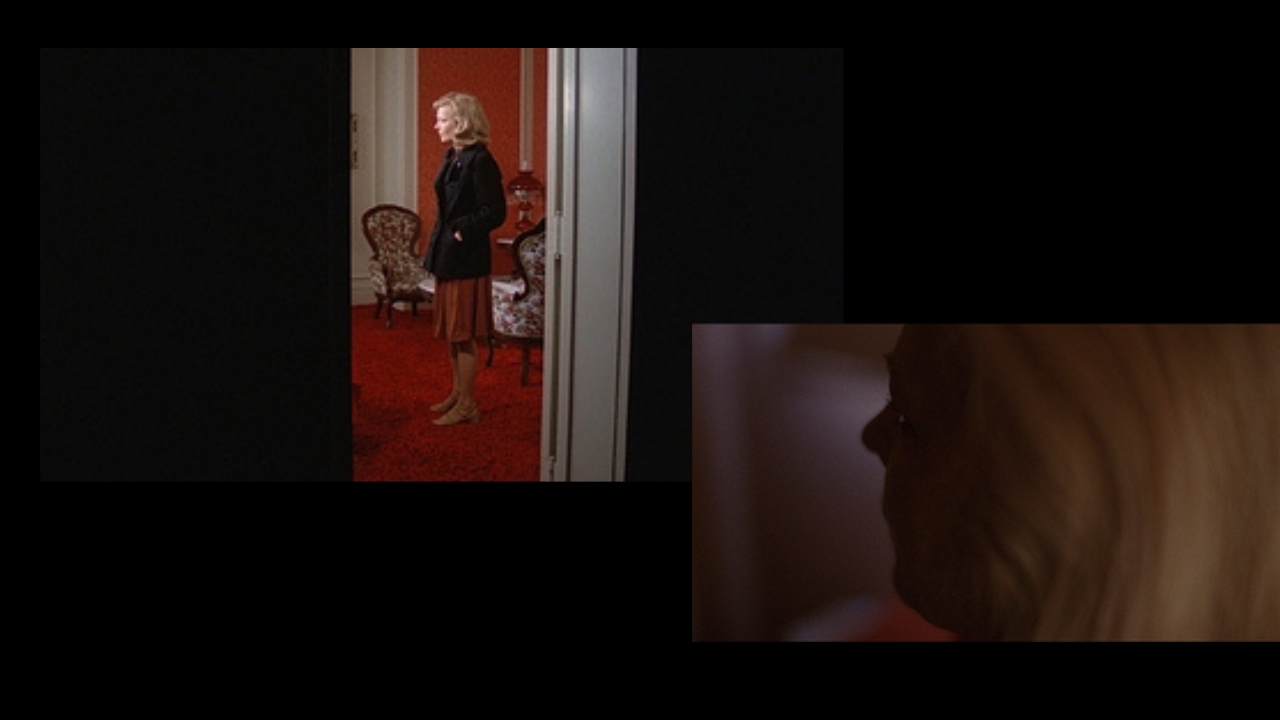
The visual ambition for this 5-feature slate is to bridge the raw, unvarnished soul of 1970s independent cinema with the precision of modern filmmaking. The entire pentalogy will be shot on high-end digital sensors (such as the Arri Alexa or RED), but the image will be heavily tailored in-camera to reflect the specific psychological state of each story.
Across the slate, the overarching visual texture will evoke the closed-grain reversal film stock that John Cassavetes utilized so beautifully. However, each film will adopt a distinct, tailored aesthetic to mirror the internal reality of its characters:
The Quietest Room
To strip back all visual contrasting distractions, The Quietest Room will be shot in high-contrast Black and White, utilizing the raw texture of a 4-X negative emulation. By shooting with the lens aperture wide open, the shallow depth of field will force audiences directly into the claustrophobic headspace of mania and psychosis. Without the comfort of color, the focus becomes purely about texture, tone, and raw emotion—from the quiet heartache of the family to the stark sterility of the hospital. The lighting will intentionally cast long, looming shadows that carry the impending threat of the racing whispers, using subtle VFX and high contrast to make the internal noise feel physically present in the room.
Disco Fries
To capture a grounded, 1970s aesthetic, the aim is to pair our modern digital sensors with vintage glass. By combining the natural flaws and flares of older lenses with a live color reversal emulation on our monitors, the film will feature a warm, sun-drenched, high-contrast look. The result is a richly grained aesthetic that feels viscerally tactile, perfectly placing the audience inside the heat, sweat, and rhythm of a 1979 disco club—which will stand in stark, chilling contrast to the peaceful, medieval atmosphere of the Kip estate castle where the cult resides.
Palliative
Serving as a sharp visual contrast to the rest of the slate, Palliative will lean into an "animated," hyper-real landscape that mirrors the kinetic energy of its cosplay world. This will be achieved using crisp, modern wide-angle lenses placed intimately close to the actors. Paired with bold, kinetic camera movements and stylized RGB lighting, the visual experience will be aggressive, precise, and deeply emotional. By pushing the camera intimately close to the performers within this hyper-real environment, it forces an unavoidable empathy from the audience, perfectly mirroring the intense emotional transitions the characters are enduring.
I’m Tired of Feeling and Unspoken & Unsighted
Because these final two films navigate intense, meta-layered realities, their visual language will serve as a stabilizing anchor, allowing those character arcs to truly come through. They will serve as the visually grounded halves to their partnering double features. Rather than utilizing heavy filters or stylized lenses, these stories will rely purely on the classic "closed-grain reversal" aesthetic established across the slate. The cinematography will be visually grounded, elegant, and beautiful—capturing a timeless, raw "opening night" energy. By keeping the camera objective, the intricate layers of the narratives are allowed to unfold naturally, trusting the strength of the ensemble to carry the weight of the shifting realities.
-
Because the production schedule is engineered for maximum efficiency, the editing process begins on set. By integrating a dedicated on-set editor or Digital Imaging Technician, we will assemble rough cuts of scenes immediately as they are shot. This real-time feedback loop ensures we capture exactly what we need without relying on costly over-coverage. By the time we wrap principal photography on each feature, a full rough assembly will already be complete. During the brief period between productions, while the ensemble decompresses and steps away from the emotional weight of the set, the producing team and I will screen this rough cut before the formal editing process begins. Once the final cuts are locked, these films will bypass the wonderful festival circuit and industry holding patterns entirely, going straight into theaters. This highly efficient workflow seamlessly feeds into our rapid-fire, month-long theatrical release strategy.
-
Theater Partnerships & The Event Catalyst
Once the cast is set, we will partner directly with theaters to establish the release infrastructure for the pentalogy. The official announcement of a month-long, double-feature movie event will serve as the primary stepping stone of our press for this project. It is entirely off this unprecedented release format and the resulting intrigue that we will build our core audience anticipation.
On-Set Editing & "Less is More" Teasers
Because our production hub integrates real-time, on-set editing, we will rapidly generate and deploy a drip-feed of cryptic, atmospheric teasers. This strict "less is more" strategy is designed to keep the audience in the dark regarding the overarching story. We are protecting the psychological integrity of the films so that viewers can experience true narrative surprise when they enter the theaters.
-
The marketing for this pentalogy will be driven entirely by the work itself. The caliber of the cast, the anticipation surrounding the project's announcement, and the deliberate drip-feed of teasers will command attention and speak for themselves. The momentum for these films will be built on the sheer excitement surrounding the unprecedented scale and high level of execution of this endeavor. If you have read the scripts, you will instantly understand why the marketing is designed in such a specific, guarded way.
Safeguarding the Ensemble & Press Run Protocol: Given the deeply sensitive nature of these works, our actors will be completely shielded from the intrusive grind of an extensive press run, especially since the films will go straight into theaters shortly after wrapping and editing are finished. Actors are given total autonomy over their promotional footprint. Once the films are released, they have the absolute freedom to collaborate with their personal publicists and teams to do as much or as little press as they wish. Furthermore, to maintain our safe, repertory company environment, we will provide a platform for them to exclusively interview their fellow castmates, or opt for a single, unified ensemble interview after we wrap. By giving the cast complete control over their narratives—including whether they desire to do interviews at all—my goal is for them to experience the movie rollout without feeling drained by the heavy subject matter of their roles. I want them to simply enjoy the audiences' reaction to the profound work they put into these characters, and to the stories that hold a mirror up to our shared humanity.
Curated Access & The Documentary Special: Pre-release visibility will bypass normal press junkets in favor of strictly curated access, potentially featuring a single, high-level ensemble interview. To satisfy the demand for behind-the-scenes insight while preserving the films' mystique, a comprehensive documentary detailing how everything came together will drop as a standalone TV special.
Pre-Production Digital Partnerships: Because these films tackle sensitive subjects, we will partner with The Bible App and leading Christian influencers to create themed devotionals and deep-dive content. These partnerships will be established early in pre-production, giving these leaders the time and space to read the scripts and craft truly comprehensive work in their analysis of the themes. By engaging in open dialogue early on, we ensure audiences are provided with genuine scriptural comfort and guidance upon release.
The "Second-Look" Script Release Strategy: To extend the cultural conversation and drive repeat box office attendance, we will execute a targeted "Second-Look" strategy for each film. On the Monday following the opening weekend of each film, we will partner with a major trade publication, such as Deadline, to exclusively release the official screenplays to the public. Because these scripts are built on deep psychological layering—containing internal monologues and motives, citing proper terms to traumas in action lines, and subtle directorial intent that audiences feel but may not overtly see on first watch—reading the text unlocks an entirely new understanding of the story. This strategy is designed to immediately drive audiences back to the theater for a second viewing, eager to experience the film again through a completely new, informed lens.
Advocacy & Illumination (Disco Fries): To parallel the psychological horror of Disco Fries, we will partner with established documentarians to release a companion documentary focused on the devastating truth behind the porn industry and sex trafficking. Where the narrative feature weaves this commentary subtly into its suspense, the documentary will explicitly illuminate how individuals are actively being trafficked on camera—exposing how symptoms of profound trauma are often visible right in front of consumers who remain blind to the exploitation. This dual-release strategy aims to shatter the illusion of the industry, spark vital conversations, and provide platforms for survivor advocacy and healing.
Experiential Empathy & Authenticity (The Quietest Room): To foster genuine empathy for those navigating mental illness in a stigmatized world, we will launch a companion website featuring a carefully designed psychosis simulator. Furthermore, we will partner with psychiatric group homes to engage with residents, utilizing the film and my own journey to create a space of shared understanding for youth navigating mental illness, showing them that they are not walking this path alone. This digital and community outreach will heighten the true-story aspect of the film, providing extra comfort to those who struggle to feel seen in their dark places.
Poetry Release & Spiritual Transparency: My ultimate goal with the release of this pentalogy is to introduce a generation to the God that comforted me in all my seasons of depression and darkness. Upon the films' release, I will draw renewed attention to my published book, Sullen Nights—which I was writing during the time of my episode in The Quietest Room—alongside the release of a new chapbook featuring the poems written directly during my hospital stay.
Awards Season Philosophy: I want to be completely transparent from the outset regarding the ultimate purpose of this pentalogy. While these scripts demand rigorous craft and feature deeply complex, enriching characters, the goal of these films is not to secure industry recognition or accolades. The true aim of this work is healing, restoration, awareness, and spiritual deliverance.
Because of this mission, I will not be submitting any of the films in this pentalogy—nor any individual performances or technical contributions—for awards consideration.
I am seeking creative partners, cast, and crew members who share this heart. It is important to me that this is known beforehand: if you are an artist who is comfortable stepping away from traditional awards campaigns to focus entirely on the impact and healing these stories can bring to the world, it would be an absolute honor to have you on board.
-
After all the anticipation and hard work from everyone attached, we enter into our pentalogy's release and a collective exhale. The safe, focused environment we built during production—supported by intimate micro-rehearsals and an agile, highly efficient set—will culminate in a groundbreaking theatrical event spanning a single month. Utilizing a rapid-fire release strategy to build compounding audience momentum as each film expands upon the interconnected world and themes, the films will hit theaters back-to-back before arriving on streaming platforms at a later date:
Week One: Double Feature (Palliative & Unspoken and Unsighted)
Week Three: Double Feature (Disco Fries & I'm Tired of Feeling)
Week Five: Single Feature Finale (The Quietest Room)
This ambitious release strategy is designed to leave a lasting impact on the hearts of audiences around the world. For both actors and audiences alike, the goal of these films is never to upheave trauma, but rather to bring closure to areas of pain. Through this cinema of truth and fly-on-the-wall approach, audiences will get to experience their beloved stars in profoundly human and honest roles.
These interconnected films are crafted to bring universal empathy, garnered through our shared humanity. This will all be made possible by the amazing cast, crew, producers, and studios who take a chance investing in an unknown multi-hyphenate artist—someone whose greatest desire is to witness the study of recognizable human behavior in elevated circumstances, brought to life by the very artists who have inspired me from the first moment I looked at a movie screen.
Given the subject of the films, through these cinematic, heightened circumstances, I aim to illuminate the beauty of the message of Christ. (Once you read the scripts, you'll see exactly what I mean. It's not a forced message, but an honest one.) Jesus stands between the threshold of our trauma and the threshold of pain. As He stands firm, when invited, He enters those dark places with us—bringing us to a place of peace and comfort through the illumination of Light and the fulfillment of Love that He is. That is my experience, and I want to share that with audiences.
If you have not yet requested a script, I invite you to do so. Once you dive into them, you will see that this entire vision and production plan is built on the foundation of truly strong material. Thank you for your time.